An official website of the United States government
Here’s how you know
Official websites use .gov A .gov website belongs to an official government organization in the United States.
Secure .gov websites use HTTPS A lock ( ) or https:// means you’ve safely connected to the .gov website. Share sensitive information only on official, secure websites.
Recovery Champions are U.S. Fish and Wildlife Service (Service) staff and their partners whose work is advancing the recovery of endangered and threatened species of plants and animals.
Members of the Laysan Finch Translocation Team release ‘ekupu’u.
Amanda Boyd – U.S. Fish and Wildlife Service
James Breeden – U.S. Fish and Wildfire Service
Robby Kohley – Pacific Rim Conservation
Peter Luscomb – Pacific Bird Conservation
Sheldon Plentovich – U.S. Fish and Wildlife Service
Liat Portner – Friends of Hawaiian Islands National Wildlife Refuge
Hope Ronco – National Oceanic and Atmospheric Administration
Rachel Rounds – U.S. Fish and Wildlife Service
Keith Swindle – Hawai’i Audubon Society
Jared Underwood – U.S. Fish and Wildlife Service
Members of the Laysan Finch (ʻEkupuʻu) Translocation Team are recognized for their leadership in recovery of the endangered bird. Following more than two decades of planning, the team established a vital insurance population for the species within Papahānaumokuākea Marine National Monument. Leveraging their technical expertise, resources, and strong partnerships, the team completed a successful translocation of the finch in 2025. This effort involved catching and transporting 100 individuals across more than 100 miles of Pacific Ocean, from Manawai to Eastern Island at Kuaihelani/Midway Atoll. Since release, the finches have thrived on Eastern Island. The appearance of hatch-year birds in October and detection of additional juveniles in February 2026 show the success of this effort.
Don Blanton – Blanton and Associates (now part of ICF)
Robin Gelston – Texas Department of Transportation
Elizabeth Hauss – ICF
Mark Kainer – ICF
Edward Paradise – Texas Department of Transportation
Rick Philips – Blanton and Associates (now part of ICF)
Ernesto Reyes, Jr. – U.S. Fish and Wildlife Service
Mitch Sternberg – U.S. Fish and Wildlife Service
Hilary Swarts – U.S. Fish and Wildlife Service
John H. Young, Jr. – Texas Department of Transportation
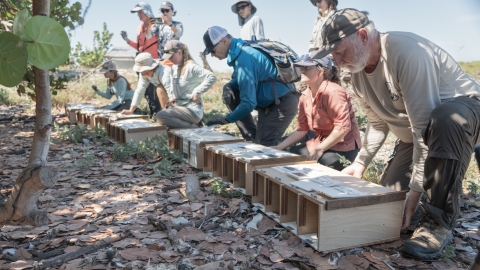
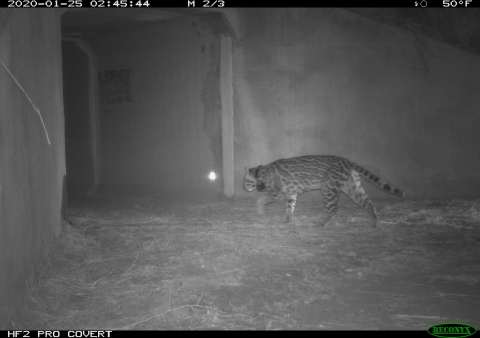
The Wildlife Crossings Ocelot Recovery Team is recognized for their leadership in advancing recovery of the endangered ocelot in South Texas. The team developed a pioneering wildlife-crossing program aimed at reducing roadway mortality—one of the greatest threats to the species. Over nearly three decades, 26 crossings have been constructed, with a total of 47 expected by 2035. Strategic fencing and native thornscrub plantings have further enhanced safe movement and habitat connectivity. Four crossings are already in use by ocelots, demonstrating measurable success. The partnership has also produced a significant scientific legacy: 22 peer-reviewed publications advancing knowledge of ocelot ecology, wildlife movement, connectivity, and the effectiveness of crossing structures. This research now guides conservation practices across Texas and informs similar efforts nationwide.
Jen Vigilant – USDA APHIS Wildlife Services-Michigan
John Vigilant – USDA APHIS Wildlife Services-Michigan
Anthony Wilson – USDA APHIS Wildlife Services-Michigan
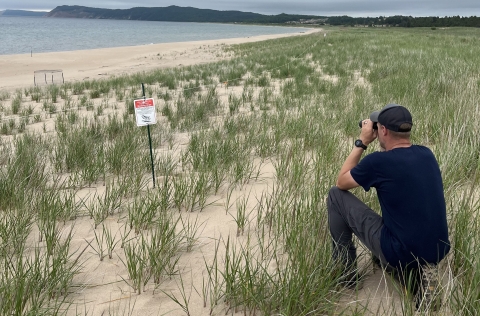
Over several decades, the Michigan Wildlife Services Team has worked closely with the Service and the Michigan Department of Natural Resources to benefit the Great Lakes piping plover, gray wolf, and Kirtland’s warbler. Through innovative predator management strategies, the team helped the Great Lakes piping plover rebound from just 13 breeding pairs in 1984 to 88 pairs in 2025. The team also advanced non-lethal techniques to address gray wolf depredations, helping Michigan maintain one of the nation’s lowest rates despite a thriving wolf population. For the Kirtland’s warbler, the team played a key role in developing new cowbird management approaches. Efforts to control cowbirds, which are known for their nest parasitism, contributed to the Kirtland’s warbler exceeding its recovery goals and ultimately being delisted in 2019.
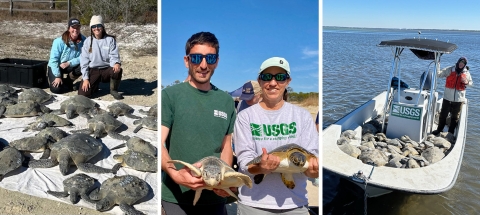
Left to right: Carson Alday, Samantha Snow, Daniel Catizone, Dr. Meg Lamont, and Joseph Alday.
Carson Alday – USGS, Wetland and Aquatic Research Center Team
Joseph Alday – USGS, Wetland and Aquatic Research Center Team
Dan Catizone – USGS, Wetland and Aquatic Research Center Team
Dr. Meg Lamont – USGS, Wetland and Aquatic Research Center Team
Samantha Snow – USGS, Wetland and Aquatic Research Center Team
The U.S. Geological Survey’s Wetland and Aquatic Research Center Team showed exemplary leadership during the January 2025 sea turtle cold stunning event in northwest Florida. Despite record-breaking cold temperatures and challenging working conditions, team members took swift action, leading fieldwork across the Gulf County peninsula and retrieving hundreds of distressed and immobile sea turtles. Working closely with state and federal agency biologists, local volunteers, and sea turtle organizations, the team coordinated efforts to bring turtles to sheltered locations, provide medical triage, and facilitate release back into the wild. Ultimately, more than 1,200 turtles were saved through immediate and careful intervention, enabling these animals to aid in the recovery of their species and contribute to the vitality of coastal ecosystems.
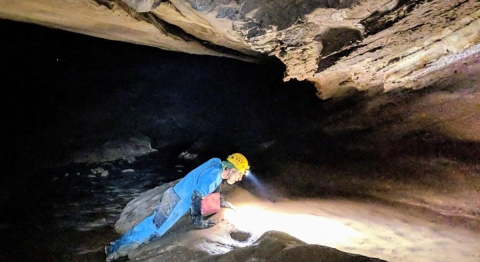
Wil Orndorff’s commitment to science‑based conservation has expanded our understanding and protection of Virginia’s sensitive karst systems and their unique species. Through his research, rigorous surveys, and innovative sampling techniques, the known range of Madison cave isopod increased from just two sites in 1982 to 19 sites across Virginia and West Virginia. His role in the establishment of the 89-acre Cave Hill Natural Area Preserve and the Dominion Power Plant Habitat Conservation Plan ensured long-term protection of the species. Orndorff’s leadership has also improved the status of the Lee County cave isopod. Years of coordination with federal, state, and local partners to address severe water contamination at Thompson Cedar Cave ultimately led to the rediscovery of the species there in 2001. Ongoing monitoring shows the isopod expanding into additional caves within the Cedars Natural Area Preserve.
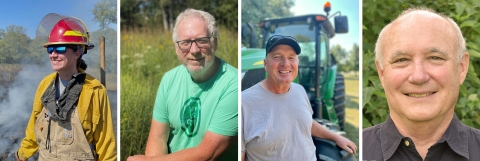
Left to right: Sheena Parsons, Bryan Foster, Bruce Johanning, and Scott Campbell.
Scott Campbell – The University of Kansas
Bryan Foster – The University of Kansas
Bruce Johanning – The University of Kansas
Sheena Parsons – The University of Kansas
The University of Kansas (KU) Field Station Experimental Ponds Team is recognized for their work to preserve the genetically distinct Willow Creek population of the Topeka shiner. This population, which is the last of the Western High Plains of Kansas, was rescued by team members in 2002 after predatory sportfish were introduced into its habitat. The population now exists only in captivity at the KU Field Station where it has reproduced successfully over many generations within experimental ponds due to the expertise and commitment of team members. The preservation of genetics from an extirpated population of the Topeka shiner will play a critical role in furthering reintroduction efforts for this endangered fish into portions of its historical range.
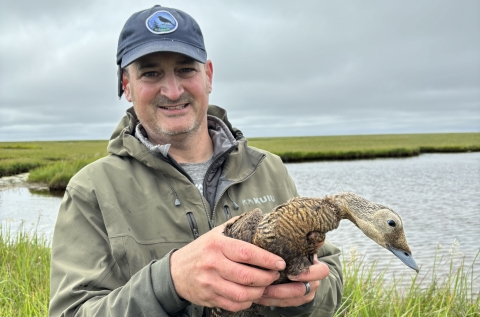
Daniel Rizzolo is recognized for his leadership in the recovery of the federally threatened spectacled and Steller’s eiders. His work has deepened our understanding of spectacled eiders and the challenges facing these large sea ducks, including changes in their distribution across the Bering Sea. Meanwhile, his commitment to rigorous data management has provided valuable insights for conservation, recovery, and management decisions for both species. Through his work with eiders, Rizzolo has cultivated strong partnerships across Alaska. He has built relationships with Alaska Native communities, served on graduate student committees, provided mentorship to students and colleagues, and supervised numerous field technicians. His ability to listen and consider the perspectives and ideas of others reflects a high level of professionalism and makes him an exceptional collaborator and mentor.
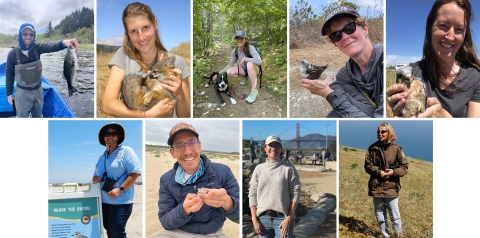
Top (left to right): Bradley Nissen, Christie Boser, Christine Fox, Cheryl Strong, and Jennifer Brown. Bottom: Katy Kughen, Micah Ashford, Rachel Tertes, and Sandy Vissan.
Micah Ashford – U.S. Fish and Wildlife Service
Christie Boser – U.S. Fish and Wildlife Service
Jennifer Brown – U.S. Fish and Wildlife Service
Christine Fox – U.S. Fish and Wildlife Service
Katy Kughen – U.S. Fish and Wildlife Service
Bradley Nissen – U.S. Fish and Wildlife Service
Cheryl Strong – U.S. Fish and Wildlife Service
Rachel Tertes – U.S. Fish and Wildlife Service
Sandy Vissman – U.S. Fish and Wildlife Service
Western Snowy Plover Species and Recovery Unit leads are recognized as recovery champions for their exemplary leadership that has advanced the recovery of the Pacific coast population of the federally threatened shorebird. Over the years, the team has cultivated a strong alliance among federal and state agencies, nonprofits, universities, and citizen scientists, all playing essential roles in research, monitoring, habitat restoration, predator management, and public outreach. These led to the documentation of 3,018 plovers during the 2025 annual Breeding Window Survey, marking the first time the count surpassed 3,000 individuals since comprehensive rangewide monitoring began in 2005. Collectively, the team and its partners have achieved a major milestone in protecting the western snowy plover, supporting its ongoing recovery and stability along the Pacific Coast.